DetOrchestration
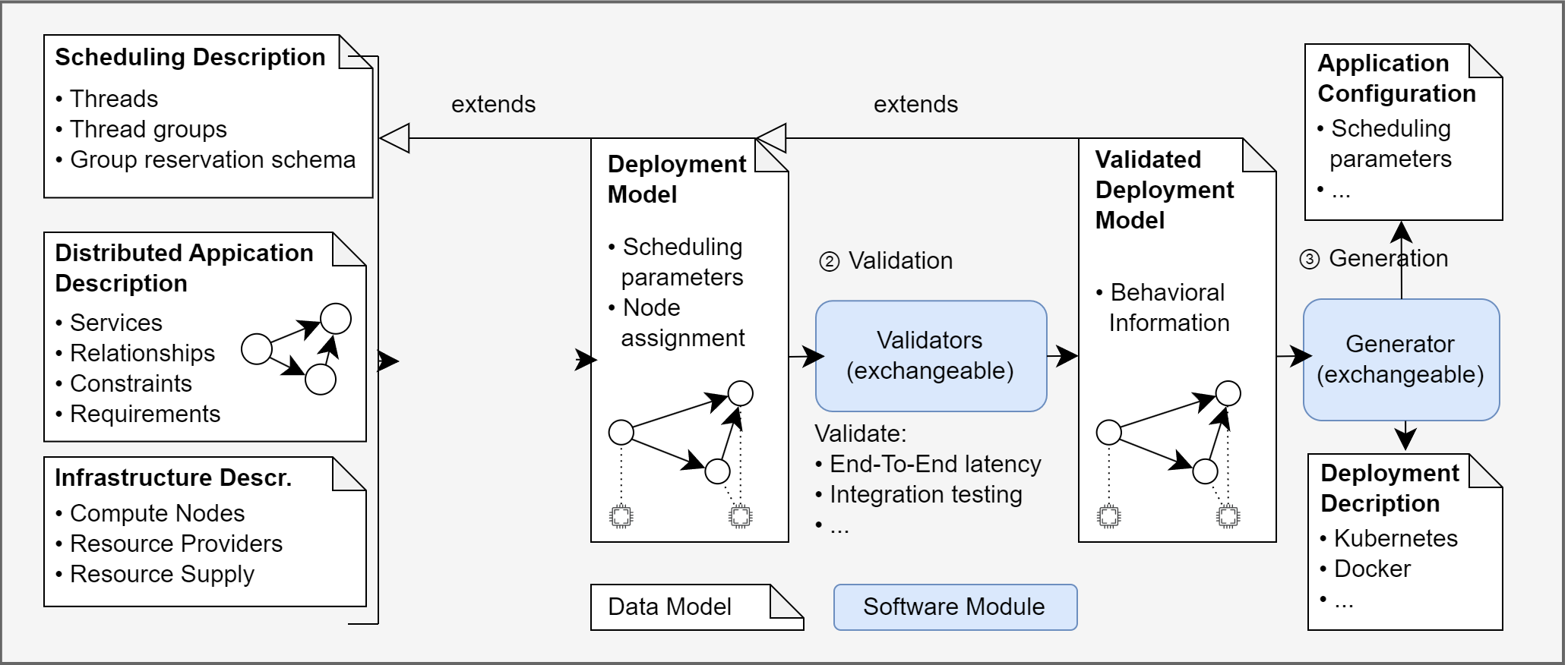
The figure provides an overview of the key information that the software components involved in real-time orchestration require. The lifecycle of a distributed real-time system (DRTApp) begins with a description of the execution model used and the composition of the DRTApp from individual services (containers). Subsequently, a scheduler, which can be integrated either into a real-time orchestrator or an external tool, assigns scheduling parameters to the services encapsulated in containers. To draw conclusions about the real-time behaviour of the DRTApp to be deployed, specific validators and user-defined validators associated with the scheduling model are used. Finally, service configuration files and deployment descriptions are generated for the runtime environment of a specific type of deployment unit.
Examples of supported runtime environments are Kubernetes and Docker for containers. The DRTApp description is meaningful enough to describe services and their communication connections via a common communication system such as time-sensitive networking. In addition, framework conditions, QoS requirements and simple resource requirements of services as well as their counterparts, the provided resources of computing nodes, can be described. In addition to a graphical modelling language, a textual domain-specific language (DSL) is also available to the user for modelling services and applications.